




Aquamarine: March Moonstone
alexandra giuguleaThe aquamarine stone is one of the most beautiful semi-precious gemstones, with a distinctive colour and a unique story.
Did you know it’s considered March’s birthstone as well as the gem for the 19th anniversary? There’s so much more to discover about it—join us as we explore together.
Both the vibrant shades and the symbolism of aquamarine have a special beauty. That’s why, when you gift an aquamarine jewel, it’s like bringing a touch of magic into someone’s life. And at Indira, we carefully choose natural aquamarine and hand-select every stone to make sure you can have the most beautiful ones.
 Photo accessory: Birthstone Golden March silver necklace - Aquamarine
Aquamarine (or aquamarine): March birthstone
Aquamarine is a semi-precious stone in blue-green hues that in ancient times was believed to protect those who travelled by sea. In the language of jewellery, it signifies hope and everlasting youth.
That’s precisely why it’s the birthstone of March, the first month of spring, when nature fills with hope and bustles with life and rejuvenation. It’s also the reason it’s given for the 19th wedding anniversary, celebrating the aspiration toward a marriage that lasts forever.
Aquamarine’s translucent, blueish hue is so reminiscent of the sea that it carries its name. In Latin, aqua means water and marinus means marine or of the sea. So aquamarine — in Romanian, acvamarin — comes from aqua marinus, which means sea water.
In Ancient Greece, legend says that Poseidon, the God of the Sea himself, created aquamarine from the ocean’s depths. How beautiful is it to wear jewellery adorned with an aquamarine stone, as if you’re always keeping a piece of the ocean with you?
Jewellery with natural aquamarine
Natural aquamarine is a stone that can take millions of years to form. That’s where the inherent beauty of jewellery featuring natural stones comes from. They’re authentic and capture the essence of what they represent: patience, eternity, beauty.
And because everything created by nature is one of a kind, no two stones look exactly alike. Each natural aquamarine is unique in the world in shape, colour, and size. A jewel with a personality of its own.
Because we want our pieces to be more than simple accessories, every aquamarine jewel on Indira is thoughtfully crafted from natural semi-precious stones. So you can celebrate your connection with your partner—or any special moment in your life—with a truly meaningful gift.
If you’re looking to gift a stone that says love and hope forever, a stone of hope and the birthstone of March, or simply a jewel that feels lifted from the ocean’s waves, you’ll fall in love with our aquamarine pieces.
Aquamarine pendant
Remember how we said above that aquamarine stones are like a touch of magic in jewelry? That’s exactly the impression an aquamarine pendant creates. Like a drop lifted from the open sea on a clear day, a stone like the one on the Birthstone March silver pendant - Aquamarine wraps you in a calm, positive aura.

Beyond being a splendid detail, such a pendant becomes an incredibly versatile gift. It’s a fine, delicate piece that can be hung from any gold or silver chain and easily paired with any other jewellery or outfit.
Have you seen Indira’s Birthstone collection?
The Birthstone collection by Indira brings together jewellery set with the stones of all 12 months of the year, including March’s gem. Bracelets, necklaces, and pendants—there are numerous natural-stone pieces you can choose from to celebrate a person or a special event you associate with a particular month.
Aquamarine bracelet
Not all women wear necklaces. Many people prefer to keep their jewellery on at all times, even while sleeping, and can’t sleep with a chain on. If you notice the person you want to gift a jewel to doesn’t usually wear necklaces, the pendant might be best saved for another occasion. A wonderful alternative can be aquamarine bracelets, like the Birthstone March silver bracelet - Aquamarine.

It’s adorned with four 4 mm aquamarine stones, making it a wonderful gift for someone born in March.
There’s also the Birthstone Golden March silver bracelet - Aquamarine, plated with 14K yellow gold in a 2-micron layer, which offers exceptional resistance to daily wear. There’s no need to take it off your wrist—even at night—because it’s made to last for years without losing its colour or lustre.
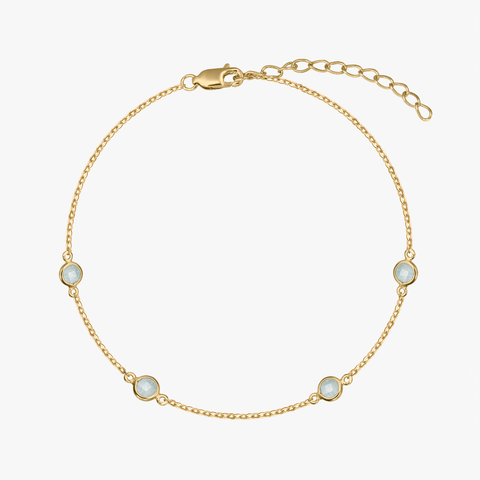
Or, if you prefer something more minimal, the Birthstone Golden March silver cord bracelet - Aquamarine or the Birthstone Silver March silver cord bracelet - Aquamarine are each decorated with a single 3 mm aquamarine. Likewise, you can choose either a 925 silver setting or one in silver plated with a 2-micron layer of 14K gold.

If bracelets with four aquamarines are ideal for celebrating your bond with someone close, a cord bracelet can be the perfect choice to gift a special person without making it feel like you’re too much. Occasions like 1st March, 8th March, or other moments when you celebrate friendship are perfect for choosing an aquamarine bracelet like this.
Aquamarine anklet
Bracelets aren’t just for wrists, and aquamarine sparkles subtly around the ankle too. A minimalist accessory that’s easy to wear with any style is the SummerScape silver anklet - Aquamarine, decorated with 2.5mm aquamarine stones. It has an adjustable length from 21 cm to 26 cm, so it sits delicately and elegantly on the ankle.

How do you clean and care for jewellery with aquamarine stones?
Aquamarine is a durable gemstone that withstands a variety of cleaning solutions. Water and soap—and even a mild acid—are sufficient to clean aquamarine without damaging it.
However, be sure to avoid contact with hydrofluoric acid (found in strong cleaning solutions and rust removers). It’s one of the few chemicals that attacks aquamarine and can negatively affect it.
Aquamarine’s exposure to heat
We can’t really say aquamarine is thermosensitive. Indeed, high temperatures can heat the stone and cause it to crack, and intense heat can alter its colour until it becomes powdery white or devoid of hue.
But there’s no need to worry on hot summer days or while you’re cooking. Major effects appear only after exposure to extreme temperatures, over 450°C.
Types of beryl: What exactly is aquamarine?
As mentioned above, aquamarine is a gemstone. In terms of composition, however, it’s a variety of beryl—a family that includes some of the world’s most valuable stones.
It shares the same chemical formula as emerald, heliodor, and morganite. The difference lies in colour: for aquamarine it’s blue-green, influenced by the elements and impurities present during the stone’s formation.
Aquamarine’s blue colour comes from iron impurities locked into the crystal structure. Other beryl types (pink, green, golden) are coloured differently by the presence of elements such as manganese (morganite) or chromium (emerald).
Beryl is a beryllium aluminium silicate mineral that can form both tiny crystals and huge ones of remarkable finesse. Aquamarine can therefore reach enormous sizes.
The largest natural aquamarine block ever found measures 48 cm and weighs 110 kg. It was discovered in the Karakorum Mountains, Pakistan.
What does raw aquamarine mean?
Have you ever heard the term raw aquamarine?
No, it’s not the same as natural aquamarine. Raw doesn’t refer to the stone’s origin—it indicates whether it has been processed. Stones that are NOT polished, rounded, or worked in any way are called raw aquamarine and keep a slightly irregular, even angular, rugged look.
Aquamarine stone: Is it a precious or semi-precious gem?
It’s often said there are only four precious gemstones in the world—diamond, sapphire, emerald, and ruby. So by that definition, aquamarine would be considered semi-precious.
And yet, aquamarine is still beryl, with the same chemical formula. The classification of those four “precious” stones was made long ago, in times when the gap in value and rarity between the two categories was much greater.
Today, many semi-precious stones are worth more than a lower-quality precious gem, are much rarer, and harder to obtain. So no natural stone is inferior to another. Each is special in a subjective way—first and foremost through the emotional connection it creates.
Aquamarine properties and characteristics
Every gemstone has certain characteristics by which it can be recognised and distinguished from the others. Here are the most important things to know about aquamarine’s properties.
Aquamarine colour
Blue is the rarest colour in nature. Have you noticed there are hardly any blue-pigmented foods? Except for a few flowers, butterflies, and very few animals, you rarely see blue in nature. Even the blue of the sea is a reflection, not a blue pigment.
Thus, aquamarine is rare not only because of the time it takes to form but also because of its crystalline blue, slightly greenish hue. Naturally, the stone ranges from light, translucent blues to intense, deep ocean blue shades.
Generally, the purer and deeper the blue, the rarer the stone—and the higher its value.
Aquamarine in natural sizes
Like all beryl types, aquamarine occurs naturally both as very small crystals of a few millimetres and as extremely large blocks, like the one discovered in Pakistan. That doesn’t mean, however, that a stone’s value increases proportionally with size.
Large aquamarines aren’t commonly used to create jewellery. Those that reach several centimetres, for example, are used only as a centre stone in a ring or necklace with aquamarine. So the most prized stones are the small and very small ones. Their price even starts to decrease after they pass the threshold of 25 carats.
The largest aquamarine gemstone in the world is shaped like an obelisk and was cut from a crystal nearly 610 cm long and 27 kg in weight. The Dom Pedro aquamarine, as it’s called, measures 36 cm in length and weighs over 2 kg (10,363 carats).
The rarity of aquamarine
Aquamarine is found all over the world, and Minas Gerais in Brazil is currently the main source. Even so, it remains moderately rare in nature: while it doesn’t rank among the top 10 rarest stones, it is the 27th rarest on the planet.
Blue topaz has a similar colour, but it doesn’t form naturally. The hue is created by irradiation from a colourless topaz.
How do you recognise a natural aquamarine stone?
Finally, here are a few things about natural aquamarine—it’s quite hard to distinguish from the synthetic version.
The main difference between the two is origin. Natural aquamarine forms over tens of thousands—even millions—of years deep within the earth, where conditions and temperatures change constantly. It’s discovered by miners in parts of Africa, the USA, India, Pakistan, and most often in Brazil.
Synthetic aquamarine is created in a laboratory, under constant temperatures and pressures, with controlled elements and impurities. These stones form more quickly, and the crystals look similar to natural ones—though not identical. The difference lies in the inclusions.
Inclusions in natural aquamarine
During the formation of natural aquamarine, tiny cracks, fractures, or impurities such as gas bubbles, fluid tubes, pyrite, rutile, or crystals of other minerals become trapped within the stone’s crystals. These are called inclusions, and they’re what make every stone unique.
Also called aquamarine gardens, they’re the reason why no two aquamarine stones are identical. Depending on their type and number, a stone’s transparency, intensity, and colour tone will vary.
In synthetic aquamarine, there are far fewer such inclusions in a single stone. They aren’t visible to the naked eye, but a specialist can tell a natural stone from a lab-created one upon examination.
FAQ: Frequently asked questions about aquamarine
1. Is there such a thing as green aquamarine?
Aquamarine is a variety of beryl defined by its blue colour. Green beryl is called emerald. Typically, aquamarine ranges from light, sky-like translucent shades to intense, pure deep-sea blues. It may have greenish tones, but we can’t call it aquamarine if the stone is green.
2. How can I tell natural aquamarine from artificial?
You can’t identify natural aquamarine with the naked eye. A jeweller, however, can detect synthetic stones, which have fewer inclusions than natural ones.
3. Does aquamarine have magical properties or is that just a myth?
Every jewel tells a story, and everyone forms a special connection with the piece they wear. If aquamarine inspires hope, courage, or any other positive emotion in you, you could certainly say it brings a touch of magic into your life.
4. Can I gift aquamarine to someone born in a month other than March?
Absolutely! Aquamarine is indeed March’s birthstone and the gem for the 19th wedding anniversary. But that doesn’t mean it’s reserved exclusively for those occasions. Above all, aquamarine signifies calm and hope, and many couples even choose it for an engagement ring as a symbol of a lasting relationship.
Gemstone meanings are meant to inspire, not limit your choices. If you love aquamarine’s distinctive hue or its story from across the seas and oceans, you can certainly wear it—or gift it—in any context. Aquamarine jewellery is versatile and pairs effortlessly with every look, making it a wonderful gift to celebrate any special moment.
Bibliography:
ADAMO, Ilaria, et al. Aquamarine, Maxixe-type beryl, and hydrothermal synthetic blue beryl: Analysis and identification. Gems & Gemology, 2008, 44.3: 214-226
“March Birthstone: Aquamarine” International Gem Society, https://www.gemsociety.org/article/march-birthstone/. Accessed on 17.02.2024
Youtz, Mandy, Koser Jewelers, “Fun Facts About Aquamarine: March’s Birthstone”, https://www.koserjewelers.com/blog-post/fun-facts-about-aquamarine-marchs-birthstone, 2022
Albertsone, Holy, The Eye of Jewelry, “Precious stones VS. semi precious stones: what are the differences between the two?”, https://theeyeofjewelry.com/stones/precious-stones-semi-precious-stones-differences/, 2018
WC Editorial Team, “Natural vs. Synthetic Aquamarine”, https://www.withclarity.com/blogs/gemstone/natural-vs-synthetic-aquamarine?vsly-redirected-from=44f515b6-d846-4f32-92ed-79e78d5a8df9-9bf5d85f-9b5f-4b15-a626-fbf45df94115. 2023
Cui S, Xu B, Shen J, Miao Z, Wang Z. Gemology, Spectroscopy, and Mineralogy Study of Aquamarines of Three Different Origins. Crystals. 2023; 13(10):1478. https://doi.org/10.3390/cryst13101478
Jullieta Enone Lum, Fanus Viljoen, Bruce Cairncross, Dirk Frei, Mineralogical and geochemical characteristics of BERYL (AQUAMARINE) from the Erongo Volcanic Complex, Namibia, Journal of African Earth Sciences, Volume 124, 2016, Pages 104-125, ISSN 1464-343X. https://doi.org/10.1016/j.jafrearsci.2016.09.006.

